
Speech pathology designed for day centres
Group programs, consultancy and staff training that improve communication across your whole centre, and make participants' funding go further.
2 hours of FREE speech pathology consultancy each week when you contract 3 hours of funded groups.
Details of special offerBenefits for your centre and your participants
Value for money therapy
Groups offer more therapy hours per funding dollar, and provide consistent access to speech pathology for participants.
Skills for real life
Participants develop skills with the people and places that are part of their lives.
Staff are involved
Staff participate, so strategies can be used throughout the centre, throughout the week.
A smoother day for everyone
When staff and participants understand each other better, activities, choices and transitions run more easily.
Have a question?
Explore
Groups
Types of groups and how they work.
See groupsSupport for your team
Consultancy for your centre and training for your staff.
See supportCosts and funding
Rates, funding and worked examples.
See costsMealtime safety
Swallowing and mealtime assessments, plans and training.
See mealtime safetyAbout Denise
Qualifications, experience and motivation.
Meet DeniseGroups
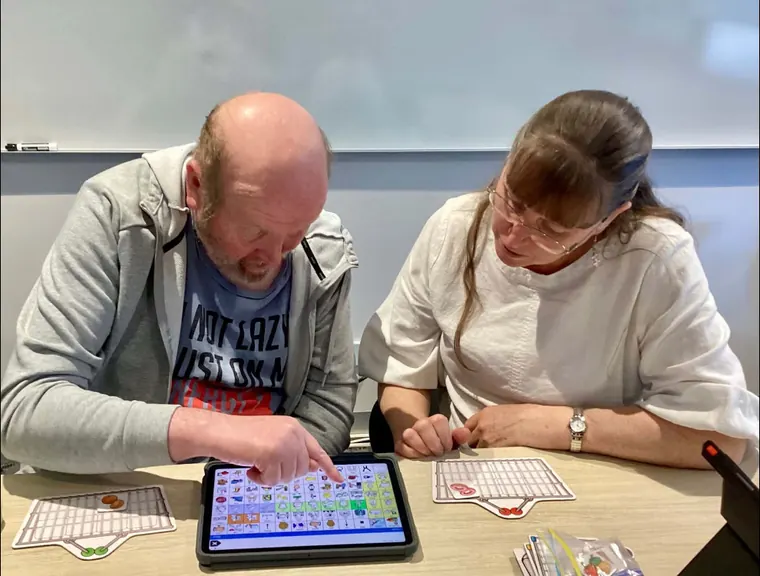
Speech pathology groups run within your existing day program schedule, working towards participants' communication, literacy and social communication goals.
Denise runs the group in your day program, with your staff supporting participants and learning the strategies being taught, so they can use the strategies they learn with participants throughout the week.
Why groups in day programs?
Access
Consistent access to speech pathology for participants on waitlists or with high turnover of therapists.
Transfer of skills
Skills from therapy sessions transfer into participants' regular environments.
Practice in real-life situations
Participants practise their skills in real-life situations, interacting with others.
Staff inclusion
Staff become better able to assist participants to use their skills within the day program.
Building capable environments
Capacity-building of environments is the main therapy activity for adults with developmental disability.
Group Program Examples
Every group is designed for the people in it.
Communicating with AAC
Conversation groups for people using communication devices, apps or boards. Could be all AAC, or one specific app, such as LAMP.
Everyday conversations
Practise conversation skills, such as initiating topics, answering questions and joining in.
Social communication
Learn skills, such as joining and leaving conversations, turn-taking, staying on topic, and using body language and tone of voice.
Reading and writing
Evidence-based teaching of phonics, spelling and comprehension, at each person's level.
Being understood
For people who speak but aren't always understood: clear speech strategies and using other ways to get the message across.
Intensive interaction
Staff learn to interact with people with minimal language skills to increase both social connection and communication skills.
Something else in mind? Small groups with compatible goals can work on almost anything. Not sure which suits your participants? Ask Denise.
How to book
Talk to Denise
Tell Denise about your centre and your participants' communication goals.
Check funding
Your centre asks participants (or their nominees) whether their plan has suitable funding.
Agree the details
You choose days and times, and sign a subcontractor agreement together.
Groups begin
- Denise provides group planning documentation and individual support plans for each participant of the group, outlining current skills and individual goals for the program.
- Denise runs weekly groups and shares short session notes with your centre.
- Denise provides a program review to the centre and individual progress reports for each participant.
Who does what?
Your centre
Names a contact person, checks participants' funding and goals, provides a room and any staffing needed, invoices participants as usual and pays Denise's invoice.
Denise
Plans each block, writes individual plans, runs the groups, shares session notes and progress reports.
Common questions
Can groups start mid-term?
Yes. Blocks can start in any week and be any length to suit your program. Many centres like 10 weeks because it fits a school term.
Already have a speech pathologist?
Participants with a current speech pathologist can access groups as long as the group goals don't double up on what is being addressed with the other speech pathologist.
Who invoices whom?
Your centre invoices participants as usual, using the speech pathology line item, then pays Denise's invoice under your subcontractor agreement.
Do we need to provide staff for the group?
Day program staff who are familiar with the participants attend for health and safety reasons and to learn the strategies to use throughout the week.
Will Denise do individual assessments and NDIS recommendations?
No, individual assessments, communication profiles, strategies and reports will not be provided to participants, other than progress reports and strategies related to group involvement.
Information for participants and families
Want to talk about a group at your centre?
Support for your team
Communication runs more smoothly throughout your centre when staff feel confident using strategies across all programs. Denise supports your team through consultancy and training.
Contract Denise for 3 hours of funded groups on one day each week and receive 2 hours of FREE consultancy on that day each week.
Ask about the offerSpeech Pathology Consultancy
Consultancy is for your centre as a whole, so it focuses on capacity building your staff and environment to achieve the greatest impact for participants. It does not involve individual assessments, communication profiles, strategies and reports.
Speech Pathology Consultancy Ideas
Solve a communication problem
"How do I let participants know what's next?" "What AAC can I use in the pool?" "How can I facilitate choice-making?" "How can participants communicate more independently in the community?"
Integrate goals into programs
Help staff work individual speech pathology goals into their programs – using AAC at the supermarket, social communication skills in the library, safe swallowing techniques in cooking.
Make resources
Core communication boards for use throughout the centre, staff training videos, visuals for individual programs.
Support existing groups
Provide guidance and fresh ideas to existing communication and literacy groups.
Extend group skills
Attend other programs of group participants so strategies are used with other staff and settings.
Review centre-wide practices
Look at current practices to improve inclusivity, eg involving less-verbal participants in program evaluation or selection of activities.
Consultancy and Staff Training can also be booked on their own, billed at the NDIS hourly rate.
Become a Communication Champion
We suggest one or more staff members become your centre's Communication Champion. It's a small, rewarding role: working with Denise so strategies keep going when she isn't there.
Staff Training
Training can be in person or online, for small or large groups, or provided as short videos your staff can watch in their own time.
There are many topics related to speech, language, communication, literacy and safe swallowing that would be useful staff training topics. Denise can develop training to suit your centre's needs.
Training Topic Ideas
- Using AAC
- Key Word Sign
- Community access cards
- Increasing choice and control
- Intensive interaction
- Getting the message across
- Mealtime safety
Curious what this could look like at your centre?
Costs and funding
All services are billed at the NDIS hourly rate for speech pathology, which is $193.99 (2026–2027). Travel time is not billed.
What you'll pay
Billed preparation, planning and reporting time varies depending on your needs, so Denise will speak with you before anything begins. You'll know the full cost before you agree to it. There are no hidden charges.
Groups funding
- Participants pay for these groups from their Allied Health funding in their NDIS plan: Capacity Building – Improved Daily Living.
- Participants are billed the NDIS hourly rate for speech pathology, divided by the number of participants in the group.
- Planning, preparation time and note writing time are billed, so a 1-hour group session is billed 1.25 hours.
- As per NDIS guidelines, before each group begins, individual support plans are designed for each participant, and individual progress reports are written at the end of each group block. Thirty minutes for each of these documents is factored into costs.
- Therefore, each 1-hour group costs 1.25 hours per week, plus 1 extra hour for the block.
Whole-group commitment. Everyone in a group commits to the whole block. Because the cost is shared, billing is the same whether or not a participant attends each session.
An example of individual participant cost for a 10-week block with 4 participants
$800.22 total cost per participant
Includes 10 hours of group sessions, plus planning, session notes and reporting.
Over a year, assuming four 10-week blocks:
$3,200.88 per participant per year
That's 54 speech pathologist hours, or 40 face-to-face hours, for 16.5 hours of funding.
Costs for other group sizes and block lengths
Blocks can be any length, and can start mid-term. Open a table below, or work out your own.
Work out your own block
Based on the NDIS hourly rate for speech pathology ($193.99, 2026–27). Costs include planning, notes, an individual support plan and an outcome report for each participant.
Common questions
Already have a speech pathologist?
Participants with a current speech pathologist can access groups as long as the group goals don't double up on what is being addressed with the other speech pathologist.
Who can use this service?
Participants with plan-managed and self-managed plans can access this service. Agency-managed (NDIA-managed) plans can't be used at this stage.
Which funding is used?
Day programs will use line item 15_622_0128_1_3 (Assessment, Recommendation, Therapy or Training: Speech Pathologist) to access participants' Capacity Building: Improved Daily Living sections of their NDIS plans. Some plan managers may request Denise's registration details to ensure that the service was delivered by a registered speech pathologist.
Who invoices whom?
Your centre invoices participants as usual, using the speech pathology line item, then pays Denise's invoice under your subcontractor agreement.
What if a participant leaves or misses sessions?
The group commits to a whole block so that costs stay steady for everyone. Talk to Denise early if circumstances change.
Questions about funding?
Mealtime safety
Denise assesses swallowing and mealtime behaviour, and writes or reviews Mealtime Management Plans, so people have safe eating and drinking with the right foods, environment and support.
A session usually includes
- Reviewing any previous plans
- Talking with carers about mealtimes, food and support given
- Observing a regular meal in its usual setting
- Trying different food consistencies and strategies if needed
- Writing or reviewing the plan, and making any required supporting resources
Assessments usually take about 1.5 hours and writing a plan 1 to 1.5 hours, billed at the NDIS hourly rate from each participant's Capacity Building: Improved Daily Living funding.
Staff training about mealtimes
Denise can also train your staff in:
Individual mealtime management plans
Understanding and following the plans of the people you support.
IDDSI levels
What they mean, why we need them, and how to prepare food to these consistencies.
Mealtime management plans in general
What information is in them, what it means and why it is important to follow them.
Need a mealtime assessment or training?
About Denise McDonough
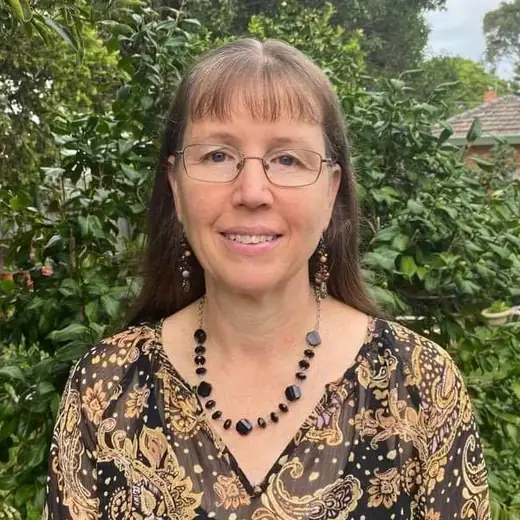
Denise works with adults who have lived with disability since birth or childhood. Many of the people Denise works with received speech pathology as children, at school, then received no more until the introduction of the NDIS and individualised funding for allied health.
Communication support has come a long way since then, and Denise loves bringing new ideas and tools to people who have missed out.
"I enjoy connecting with people who have limited ability to communicate, and for them to see that someone is interested in what they have to say. When they realise that they can connect with me and get their message across, it is very empowering for them, which really fills my cup."
Credentials
Certified Practising Speech Pathologist and registered special education teacher (Victorian Institute of Teaching).
Master of Speech Pathology, La Trobe University. Graduate Diploma of Special Education, University of Melbourne.
Denise holds current NDIS Worker Screening, a Working With Children Check, and professional indemnity and public liability insurance.
Ask Denise a questionSpeech pathology groups run in day programs
For participants and families
A speech pathology group is a small group of people working on their communication goals together, with a qualified speech pathologist.
Your goals
Denise will talk with you and/or your nominee about your communication goals. The group addresses those goals.
Your plan
You will receive an individual plan for the group, and a progress report when the group finishes.
Your privacy
Denise follows privacy policies and keeps notes in secure software. The privacy policy is available below.
Common questions
Why is this better than what we have been doing before?
Group therapy costs much less than one-to-one therapy, so you will receive more therapy than your funding would usually allow. Having therapy within your day program allows you to use your skills across the centre, throughout the week. When your support people are involved in your group, they develop the skills and learn the strategies so they can support you outside of the group.
What does it cost?
Your day program can tell you the exact amount. See Costs and funding for more details.
Which funding do I use?
Groups are paid for with your Capacity Building – Improved Daily Living NDIS funding.
I already see a speech pathologist. Can I still join?
Participants with a current speech pathologist can access groups as long as the group goals don't double up on what is being addressed with the other speech pathologist.
What other services do Speech Pathology Partnerships provide?
Denise also provides consultancy and staff training for day programs, and mealtime safety assessments and plans. Explore the rest of the website.
An Easy Read version of this page is planned.
Get in touch
Ask anything about groups, consultancy, staff training or funding.
Call or text: 0406 678 076
Email: denisesmcdonough@gmail.com
Area: Melbourne's South East
What happens next
- Denise replies within 3 business days.
- You chat about your centre and participants' communication goals.
- Your centre checks which participants' plans suit.
- You agree days, times and details, and sign a subcontractor agreement.
Privacy and complaints
Privacy
[Required privacy statement to be supplied by Denise.]
Read the Privacy Policy and Information Collection Statement (PDF)
Complaints
[Plain-language explanation of how to make a complaint and how it is handled, to be supplied by Denise.]
Policies
- Privacy policy and information collection statement
- Complaints management policy and procedure
- Cancellation policy
- Infection prevention and control guidelines
- Phone, video and photography policy
- AI use policy
PDFs will be added as each policy is completed.